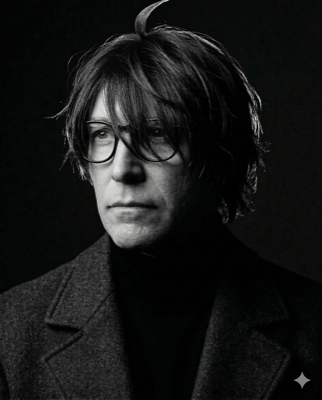
Yoshimasa Terui came from an entirely different place.
Post-Rock, Idols, and Jujutsu Kaisen
Terui's career as a musician began with the alternative rock band "Haisuinonasa," formed in 2004. Known for intricate compositions sometimes described as math rock and delicate yet avant-garde sound design, they were a cult favorite among music enthusiasts. He later formed siraph with Michiyuki Hasuo (formerly of school food punishment) and others, and also served as music producer for the idol group "sora tob sakana."
A bandman, an idol producer, a songwriter. An ordinary inhabitant of the general music scene, with no connection to film scoring.
Then in 2020, he was tapped to score the TV anime *Jujutsu Kaisen*. It was his very first scoring job. In an interview with SPICE, Terui himself acknowledged that "this was my first experience with film scoring." Season 1 was a three-person team with Hiroaki Tsutsumi and Arisa Okehazama. Supported by two experienced composers, he entered the production as an "outsider element."
Like a Comet
But the music this "outsider element" produced was extraordinary.
From Season 1, the quality of Terui's compositions stood out. "Jujutsu Sorcerer — Megumi Fushiguro," which plays during Fushiguro's Domain Expansion scene, is a track that simultaneously captures the character's resolve and inner stillness — transcending the conventional boundaries of film scoring.
Then in Season 2 — "Hidden Inventory/Premature Death" and "Shibuya Incident" — Terui stepped forward as the lead composer. In a Kompass interview, Terui revealed that he personally proposed incorporating minimal elements into the occult-themed music. "Occult music has elements of trance through repetition. It's tribal, primal — the rhythm at the core is simple, but as it repeats, it builds and elevates." A bandman's sensibility had given birth to a new grammar of scoring.
A Piano Piece Written by a Guitarist
The track that most concisely demonstrates the breadth of Terui's musicality is a piano piece called "Together."
Included in the Season 2 "Hidden Inventory/Premature Death" soundtrack, this piece quietly portrays the sorrow and poignancy of Star Plasma Vessel Riko Amanai's final days — the irreplaceable time spent with her maid Kuroi before assimilation with Tengen. And beneath that melody, you can also hear the sadness of Gojo and Geto drifting apart, heading toward their irreversible split. The surface narrative and the deeper narrative coexist within a single piano piece.
A person who had been playing guitar in the fields of post-rock and math rock could write such a delicate, multilayered piano composition. That fact astonished me.
Come to think of it, even Haisuinonasa's compositions had a visual quality within their band sound — a texture that evoked landscapes. Terui himself has said in interviews that he was "interested in the relationship between music and visuals." The instinct for creating landscapes through meticulous sound design was already there during his band days. It was just that when it was poured into the vessel of "film scoring," an explosive chemical reaction occurred.
What's Happening in the World of Anime Scoring
Yoshimasa Terui's emergence is emblematic of the changes happening in the world of anime scoring.
Scoring was once made by scoring specialists. Hiroyuki Sawano was involved in drama and film scoring from his teens. Yoko Kanno began her composing career with game music for Koei's *Romance of the Three Kingdoms* and *Nobunaga's Ambition* series, moved through commercial music, and then entered the world of anime scoring. They were artisans who spent long years mastering the grammar of scoring — synchronization with visuals, emotional direction, transitions between scenes.
But now, musicians with entirely different backgrounds are producing results at the very forefront of scoring. Terui began his career as a post-rock band guitarist, honed his craft as an idol producer, and discovered film scoring as a new field beyond that. Moreover, in addition to *Jujutsu Kaisen*, Terui is currently scoring *Mobile Suit Gundam GQuuuuuuX*, a new installment in the Gundam franchise airing in 2025. The composer who appeared like a comet is establishing himself at the core of anime music.
This connects to what I wrote about Shinichiro Watanabe in the fourth installment. Watanabe invited club music and spiritual jazz artists into anime. Terui crossed over from the band scene into anime scoring himself. The directions are opposite, but what's happening is the same: anime music is breaking free from the enclosed worlds of conventional "anisong" and "film scoring" and beginning to connect with talent from every musical genre.
The Place Where Musical Genres Dissolve
What I've wanted to convey throughout this series ultimately comes down to one thing. Anime music is no longer a world small enough to be wrapped up in the word "anisong."
90s anime tie-ups drew in Japanese pop musicians. K-pop entered as a market cultivation strategy. SZA and Guns N' Roses provided their songs. Kamasi Washington personally asked to write an opening. And a post-rock guitarist transformed the landscape of scoring entirely. Genre walls, national borders, career contexts — everything is dissolving.
And the music born in that dissolved space — we get to hear it in real time. Music multiplied by story, bound to characters' emotions, condensed into 90-second OP/EDs or fleeting moments within episodes.
Just as Terui was influenced by Yoko Kanno, someday a young musician inspired by Terui will emerge wanting to create anime music. As long as that chain continues, the world of anime music will only grow richer.
Beyond the Anisong — the other side of anisong is still expanding, endlessly.